Serving the Pacific Northwest and Puget Sound area







K-Guard vs. Traditional Gutter Guards: What Actually Works in Heavy Douglas Fir Coverage
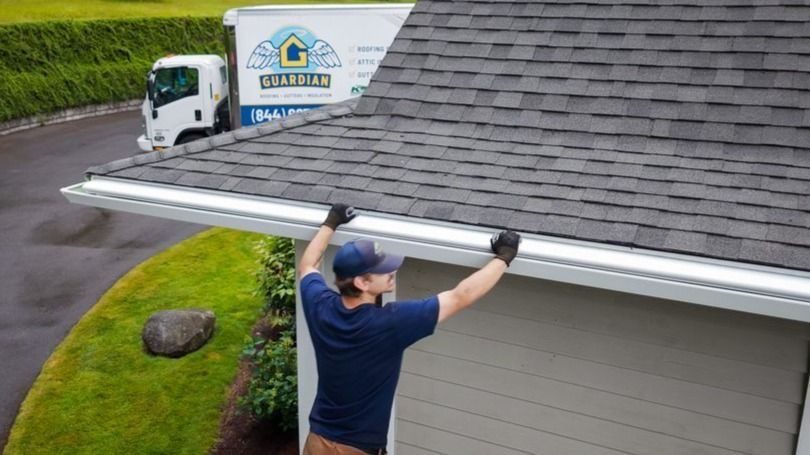
Homes surrounded by Douglas firs face a different gutter challenge than properties dealing mainly with broad leaves. Fir needles are narrow enough to work through some gutter guards, while cones, twigs, moss, and roof debris can collect on top of guards and interfere with drainage.
In this guide, we compare K-Guard with traditional screens, micro-mesh products, and other gutter guards for Pacific Northwest homes with heavy evergreen coverage. For homeowners dealing with recurring needle clogs, the best system must manage small debris and heavy runoff while fitting the condition and capacity of the existing gutters.
Is K-Guard Better Than Traditional Gutter Guards for Douglas Fir Needles?
K-Guard can be a strong option for homes with heavy Douglas fir coverage because it is designed as a complete covered gutter system rather than a screen placed over an existing gutter. Traditional guards can also work, particularly high-quality micro-mesh products, but their performance still depends heavily on the existing gutter size, pitch, downspouts, and condition.
K-Guard specifically identifies pine needles, leaves, twigs, and other small debris among the materials its covered design is intended to keep out.
When comparing systems, consider:
-
How much evergreen debris reaches the roof
-
Whether needles can enter through guard openings
-
How debris behaves on top of the guard
-
Gutter and downspout capacity
-
Roof valleys and concentrated runoff
-
Existing gutter condition
-
Maintenance requirements
-
Whether the gutters already need replacement
No gutter protection product should be selected based only on the guard itself. The entire drainage system matters.
Why Are Douglas Fir Needles So Difficult for Gutters?
Douglas fir is an evergreen conifer found extensively across Washington and Oregon. Like other evergreens, it retains foliage throughout the year but still sheds older needles as part of its normal growth cycle.
That creates a different debris pattern from a deciduous tree that produces one major leaf drop.
A heavily wooded property may collect:
-
Long, narrow needles
-
Small twigs
-
Cones and cone fragments
-
Moss
-
Bark particles
-
Roof granules
-
Windblown organic debris
Needles are particularly troublesome because they can slip through openings that would easily stop a maple or oak leaf. They may also bridge across screen openings, catch additional material, and form a mat when wet.
Roof valleys can intensify the problem. Water and debris from two roof surfaces may concentrate into a relatively small section of gutter. Even a good gutter guard can struggle when debris buildup and heavy runoff reach the same area simultaneously.
Guardian Roofing, Gutters & Insulation specifically identifies pine needles, leaves, and roof granules as common sources of gutter buildup in Washington and Oregon.
How Do Basic Screen Gutter Guards Perform Under Fir Trees?
Basic screen guards are generally designed to stop larger debris while allowing rainwater to pass through openings in the screen.
That can work reasonably well where the main problem is broad leaves. Heavy evergreen coverage creates a more difficult test.
Larger screen openings may:
-
Allow narrow needles into the gutter
-
Catch needles vertically in the openings
-
Collect twigs on the surface
-
Hold wet organic material
-
Require periodic cleaning
-
Leave existing gutter problems unchanged
If needles enter the gutter, they may eventually reach the downspout and contribute to clogs.
A screen also does not correct sagging gutters, inadequate pitch, undersized downspouts, leaking seams, or gutters that are too small for the roof area. Adding protection to a poorly performing gutter can leave the original drainage problem intact.
Basic screens may still be appropriate for homes with lighter tree coverage and gutters that are already in excellent condition. The debris load should determine the product choice.
Are Micro-Mesh Gutter Guards Better for Small Needles?
Micro-mesh guards use much smaller openings than basic screens. That gives them an advantage when the goal is keeping narrow needles and fine debris from entering the gutter.
For a Douglas fir property, a professionally selected micro-mesh guard may offer:
-
Better exclusion of small needles
-
Protection while retaining existing gutters
-
Smaller openings for fine debris
-
A lower-cost alternative to full gutter replacement in some cases
However, smaller openings introduce another consideration. Debris that cannot enter the gutter may remain on the surface.
Wet needles, moss, roof granules, and organic material can accumulate over time. Depending on roof pitch, wind exposure, and product design, some debris may blow away or wash off while other material may need to be removed.
A micro-mesh system therefore should not be treated as automatically maintenance-free.
The existing drainage system also remains important. If the gutter is undersized, improperly pitched, or already damaged, covering it with premium mesh does not correct those underlying conditions.
How Does K-Guard Handle Needles and Heavy Rain Differently?
K-Guard differs from many traditional gutter guards because the gutter and protective cover are designed as one integrated system. K-Guard describes the product as a fully engineered seamless gutter system rather than an add-on topper for an existing gutter.
The design uses a curved hood intended to direct rainwater into the gutter while allowing leaves, needles, and other debris to move across the exterior. Guardian describes the system as designed to keep pine needles and other debris out while maintaining water flow.
That integrated approach matters because gutter protection performance depends on more than the opening where water enters.
The complete system includes:
-
The gutter trough
-
Protective hood
-
Hangers
-
Downspouts
-
Drainage pathways
-
Placement relative to the roofline
K-Guard also incorporates an additional rear drainage channel into its design. The manufacturer presents this as another path for water to enter the system during demanding conditions.
For homes surrounded by fir trees, the primary advantage is that the system is designed around debris exclusion and water management together instead of placing a separate screen on top of an existing gutter.
Is Replacing the Entire Gutter System Better Than Adding Guards?
Not necessarily. The answer depends largely on the condition of your current gutters.
If your gutters are relatively new, properly sized, correctly pitched, and draining effectively, replacing the entire system solely to add protection may not be necessary. A high-quality retrofit guard could be a reasonable solution.
A complete gutter system deserves stronger consideration when existing gutters have:
-
Sagging sections
-
Chronic overflow
-
Leaking seams
-
Loose hangers
-
Corrosion or physical damage
-
Poor pitch
-
Undersized downspouts
-
Repeated clogs
-
Insufficient capacity at roof valleys
An integrated system allows the contractor to address the gutter and debris protection at the same time.
K-Guard is specifically designed as a replacement gutter and cover system. By comparison, most screens and guard products rely on the existing gutter beneath them.
This distinction can be particularly important on older Pacific Northwest homes where the gutter itself may be contributing to drainage issues.
Do K-Guard Gutters Still Need Maintenance?
Homeowners should be cautious about assuming that any exterior drainage system requires absolutely no attention.
A covered gutter may greatly reduce the amount of debris entering the trough, but other areas of the roof and drainage system should still be inspected periodically.
Homeowners may need to monitor:
-
Roof valleys
-
Downspout discharge areas
-
Moss accumulation
-
Branches resting on the roof
-
Exterior debris on gutter covers
-
Storm damage
-
Loose or damaged components
-
Drainage around the foundation
K-Guard and Guardian market the system as leaf-free and clog-resistant, with Guardian currently advertising a no-clog guarantee on its K-Guard installations. Those are company and manufacturer warranty claims, so homeowners should review the applicable terms for their specific installation.
Routine exterior inspection is still useful after major storms or tree damage.
What Happens During Pacific Northwest Downpours?
Keeping needles out of the gutter solves only part of the problem. The system must also move roof runoff efficiently.
During periods of heavy rain, water can become concentrated around:
-
Large roof planes
-
Steep roof sections
-
Roof valleys
-
Dormers
-
Upper roofs draining onto lower roofs
-
Long gutter runs
Debris buildup near these locations can make overflow more likely.
This is why homeowners should evaluate gutter protection and water capacity together. Guardian notes that Pacific Northwest homes frequently deal with heavy tree coverage and debris that can eventually move into and obstruct downspouts.
A contractor should inspect how water moves across the roof before recommending a system. Simply choosing the smallest screen openings does not guarantee that the drainage system can manage concentrated runoff.
When Does K-Guard Make More Sense Than a Traditional Guard?
K-Guard may be worth stronger consideration when:
-
Douglas firs heavily overhang the home
-
Needle clogs return repeatedly
-
Existing gutter cleaning is frequent
-
Current gutters are approaching replacement
-
Gutters sag or drain poorly
-
The property receives substantial roof runoff
-
Downspout performance needs improvement
-
The homeowner wants an integrated gutter and protection system
The opportunity to replace deteriorated gutters and add debris protection in one project can make an integrated system especially practical.
Heavy evergreen coverage is also where the difference between blocking leaves and blocking fine debris becomes more important.
When Might a Traditional Gutter Guard Still Be Enough?
K-Guard is not automatically necessary for every home with nearby trees.
A traditional guard may remain a practical choice when:
-
Existing gutters are relatively new
-
Gutters have adequate capacity
-
Pitch and drainage are correct
-
Tree coverage is moderate
-
Roof valleys do not create severe debris concentration
-
A suitable micro-mesh product handles the local debris
-
The homeowner wants to retain the existing gutters
Guardian offers multiple gutter-protection options, including K-Guard and other professional guard systems, allowing the recommendation to be based on the property rather than one universal product.
What Should Be Checked Before Choosing Any Gutter Guard?
The best gutter guard is the one matched to your roof, trees, rainfall, and existing drainage system.
Before installation, have a professional evaluate:
-
Type and density of surrounding trees
-
Roof pitch
-
Roof valleys
-
Existing gutter size
-
Gutter pitch
-
Hanger condition
-
Downspout size and placement
-
Signs of overflow
-
Fascia condition
-
Existing leaks
-
Roof drainage patterns
-
Areas where debris accumulates most heavily
Pay particular attention to recurring problems. If the same section overflows every winter despite cleaning, the issue may involve capacity or drainage design as well as debris.
Choose Gutter Protection for the Debris You Actually Have
Homes surrounded by Douglas firs need gutter protection that can handle small needles, twigs, cones, moss, and frequent Pacific Northwest rainfall. Basic screens may stop larger debris but allow needles through, while micro-mesh guards can provide finer filtration when the existing gutters are already working correctly.
K-Guard takes a different approach by combining the gutter and protective hood into one integrated drainage system. That can make it especially worth considering when heavy evergreen debris and aging or poorly performing gutters are both part of the problem.
Guardian Roofing, Gutters & Insulation helps Washington and Oregon homeowners evaluate their roof drainage, existing gutters, tree coverage, and debris conditions before recommending K-Guard or another gutter protection solution. If Douglas fir needles are making gutter maintenance a constant problem at your home, contact us today to schedule a gutter inspection.



Schedule Your Service With Us Today
Offering 5-Star Service To The PNW and puget sound Area