Serving the Pacific Northwest and Puget Sound area





Blown-In Cellulose Insulation
Northwest winters are long rather than brutal. Heating systems in Washington and Oregon run from October well into spring, and a thin or settled layer of attic insulation lets that heat drift straight up through the ceiling for months. Blown-in cellulose fills an attic floor in one continuous layer, packing around joists, wiring, and fixtures where rolled insulation leaves gaps.
Call or contact us online to schedule a free attic insulation estimate with Guardian.
Signs Your Attic Needs Blown-In Cellulose
Many homes in the region were built under far lower insulation standards, and older insulation compresses over time.
-
Visible Joists. If you can see the tops of the ceiling joists, there’s likely well under a foot of insulation, far below current recommendations.
-
Uneven Room Temperatures. Upstairs bedrooms that run cold in winter and hot in August often sit under thin or patchy insulation.
-
Rising Heating Bills. A furnace or heat pump running longer each season can point to heat escaping through the ceiling.
-
Frost or Damp Sheathing in the Attic. Warm household air leaking upward condenses on the cold roof deck in winter, a sign the ceiling isn’t sealed or insulated well enough.
-
Damaged or Dirty Insulation. Old insulation that’s matted, wet, or contaminated by rodents loses most of its value and usually needs to be removed first.
Blown-In Cellulose Attic Insulation
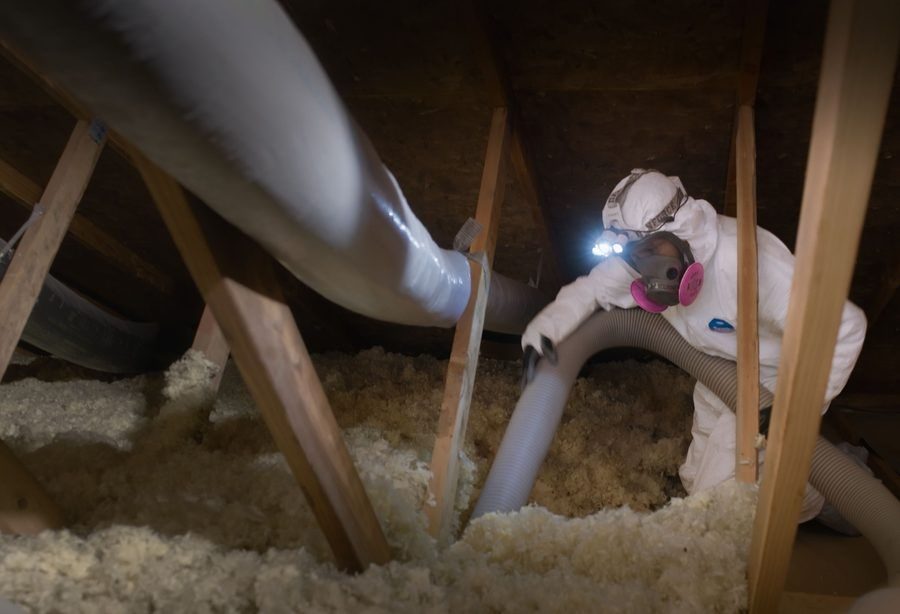
Cellulose is made mostly from recycled paper fiber treated with borate, which gives it fire resistance and makes it unappealing to insects and rodents. It’s installed with a blowing machine that feeds the loose material through a hose into the attic, where our crew spreads it in an even layer across the attic floor. As loose fill, it settles around obstructions and over ceiling framing, leaving fewer voids than rolled products.
Cellulose also has a higher R-value per inch than loose-fill fiberglass, and its density slows air movement through the insulation layer.
Every cellulose project starts with a full attic inspection. Our attic insulation process covers the steps that make new insulation pay off:
-
Assessing Existing Material. We check depth, condition, and signs of moisture or pests. Clean, dry insulation can often stay in place with cellulose blown over it.
-
Air Sealing. Gaps around light fixtures, plumbing stacks, top plates, and the attic hatch are sealed before insulation goes in, since insulation alone doesn’t stop air leaks.
-
Protecting Ventilation. Baffles are installed at the eaves so cellulose doesn’t block soffit vents and cut off airflow to the attic.
-
Installing to Depth. Depth markers are placed across the attic so the finished layer reaches the target R-value across the whole attic.
For most of Washington and Oregon, Energy Star’s attic recommendations fall in the R-38 to R-60 range, depending on climate zone and how much insulation is already there. Western Washington and western Oregon sit in a milder marine zone, while eastern Washington’s colder winters call for the higher end.
Cellulose and Your Roof
Attic insulation and roof performance are closely linked. When warm, humid household air leaks into the attic, it meets the cold underside of the roof deck and condenses, which can lead to mold, wet sheathing, and shortened shingle life. Air sealing and cellulose together keep that warm air below the ceiling. Our article on how proper attic insulation helps your roof explains the connection in more detail.
Removing Old Insulation First
If existing insulation is wet, moldy, or contaminated with rodent droppings, blowing cellulose over it traps the problem. In those cases, we remove the old material and clean the attic before installation. Our broader attic services cover inspections, cleaning, and ventilation work.
Schedule Your Service With Us Today
Offering 5-Star roofing, gutter and insulation Services to the PNW and Puget Sound area.

Why Choose Guardian Roofing for Blown-In Cellulose?
Guardian has served homeowners in Washington and Oregon since 2005, and because our core work is roofing, we look at insulation, ventilation, and the roof deck as one system. That matters in the Northwest, where most attic problems are moisture problems. Financing is available through Upgrade, and checking your options won’t affect your credit score.
Call today for a free estimate on blown-in cellulose insulation for your attic.
$1,000 OFF
New K-Guard Gutter System$8,000 Minimum Purchase
Expires:
Nov 30, 2026
Terms and Conditions apply, Coupons cannot be combined with other offers.
Terms and Conditions apply, Coupons cannot be combined with other offers.

Protect Your Roof Year-Round
Keep your roof in top shape with the Guardian Protection Plan and enjoy ongoing maintenance, priority service, and exclusive savings.Contact Us
FAQS
Frequently Asked Questions
Guardian Roofing has a knowledgable and experienced team that can help answer a variety of questions you may have.TESTIMONIALS
Testimonials From
Our Valued Clients

I was satisfied with Dylan spending time with a diagnosis of the gutter condition and then suggestions of how to t a ke care of problems. Though no work is done yet.

Nivedita Dave
3 days ago
Very thorough ad helpful. Repairs will happen in a couple weeks, but he did do a temporary fix on the gutters.

Barb Walker
3 days ago
I had a leak late on a Saturday night. The answering service rep, Sean, got in touch with people at Guardian that night, and they called me to assess the situation. The next morning I got on Greg’s schedule to come out on Sunday. He inspected the issue, came up with a plan, and put a tarp on for a temporary cover. He gave me what I consider a fair price for the repair. The next morning, the crew was at my house before the rain started up again. Christian, Jesse, and Marco did great work and got it done before more rain started.
Everyone at this company has been amazing to work with. They have a great thing going for them. Their customer service is great, and the finished product excellent. They will be my regular roof maintenance company moving forward.
Everyone at this company has been amazing to work with. They have a great thing going for them. Their customer service is great, and the finished product excellent. They will be my regular roof maintenance company moving forward.

John Emerick
3 days ago
The technician, Henry V was amazing. He arrived on time having given a heads up a at 8 AM. He fixed the roof caps before the late morning clouds came. He was able to clean the very large moldy roof and gutter and mold protect them before dark. I live in the Seattle area were rain is common in November. By late afternoon it was raining heavily at times. Despite this, Henry finished a 2 day job in one day an left the site immaculate. He even made sure water never entered the house.
Lydia, the project engineer, coordinated the job perfectly. The next day I noticed that 4 windows with screens didn’t wash off. Lydia promised to send a tech to clean them.
I highly recommend Guardian Roofing
Mark Hughs
Lydia, the project engineer, coordinated the job perfectly. The next day I noticed that 4 windows with screens didn’t wash off. Lydia promised to send a tech to clean them.
I highly recommend Guardian Roofing
Mark Hughs

Mark Hughs
3 days ago
Very professional, friendly and considerate. They were the most detailed in their inspection of the roof and attic. They used advanced technology during their assessment and presentation. they explained in detail what they would do to reroof the house. Being a Platinum installer they are a little more costly.

Arff
6 days ago
Guardian Roofing delivers honest, quality work backed by excellent customer service.
Our roof replacement was completed in just one day at the end of October 2026. The crew also replaced the roof on our backyard barn. Throughout the entire process, the teams were professional, courteous, friendly, kind, and hardworking.
I initially had a concern about the flashing installation near our front entrance, which I thought might have been installed incorrectly based on my view from ground level. However, after seeing the installation at eye level, I was able to confirm that it had been done correctly.
What impressed me most was Guardian Roofing's responsiveness. Their customer service representatives took my concern seriously and arranged for a crew to come out the very same day to inspect the area and address my questions. That level of attention and commitment to customer satisfaction speaks volumes about the company.
Overall, I am very pleased with the workmanship, professionalism, and customer service we received. I confidently recommend Guardian Roofing to anyone in the Tacoma area looking for reliable roofing services.
I would absolutely choose Guardian Roofing again for any future roofing needs.

J
7 days ago
Inspection went well. He was knowledgeable in his job. Nothing price wise was discussed nor recommendations made, as I had to place my wife in the hospital.

Paul Baty
7 days ago
Guardian Roofing did a wonderful job getting my whole roof replaced before the winter rain here in Oregon! It can be intimidating finding someone to do a big job like this when you've just moved to the area but I felt reassured every step of the way.
Unlike some of the other companies I got quotes from, Guardian never put me through high pressure sales tactics and they had a very fair price. It was clear that they'd been doing this a long time and that the shingle manufacturer trusted them enough to warranty their labor.
See you again in 30 years or so Guardian! ♥️
Ryan, Cristian, and Logan, you did great!

Olivia Morin
7 days ago
This is the second roofing job that Guardian has done for us and we could not be happier. Jim was a true professional. He was thorough and extremely helpful in assisting with homeowners insurance. He really went over and above. We are so grateful! As to the actual job, it is really beautiful. We were out of town at the time and when we returned, we had an amazing new roof. The clean up was excellent. The yard looked better after the job than before. Give these folks a try, you won't be disappointed. Great value and the people are amazing.
Well, we are on job #3 with Guardian! This time it was roof cleaning and moss treatment. Cannot say enough about our experience with this company. They are thorough and treat our home as if they live here. Luis was our technician this time around and in spite of torrential downpour, weather conditions that would deter a duck, these men were amazing. They even cleaned up leaves and put them in a neat little pile, which had nothing to do with the roof! Great job and worth every penny. Thank you very much!
Job #4! Damage from a falling tree tree branch.
Joe was our roof inspector/estimator. He was thorough, knowledgeable and extremely courteous. He did a complete inspection, answered every question and addressed our concerns. Just a great experience, we felt so much better after talking to him. Everything is going to be ok! These guys are great.

Dr. TJ Saigo, DPM
7 days ago
Dylan and Trevor arrived on the dot, were very polite and respectful of our home. His inspection inside the attic was thourough and the video presentation showing their findings inside and out were shockingly well produced

Highbrow Stonebender
1 week ago
Gutters were thoroughly cleaned. Fidel also pointed out two shingles that will need repair. Beyond that he applied temporary cover for them. He arrived on time and I think he even blew debris off back deck area. Thanks for a job well done!

Rex Mohrmann
1 week ago
Deepesh was so thorough and helpful.

Craig Metcalf
1 week ago
Josh was awesome. Very professional, informative, courteous, and answered all our questions and concerns. We felt that we were in good hands and felt very confident

Virginia Augustine
1 week ago
Their representative, Max, was very courteous and explained they could not put my chimney cap on and that I needed a hvac person. He noted that there was a small area that needed some new tiles n give me an estimate. I thought he was very honest, the price reasonable and I would not hesitate to hire them.

Tina M
1 week ago
Absolutely thorough. Explained everything clearly. Took me through photos of my roof and chimney carefully. Clearly knows what he’s doing. Was respectful of my house and property.

Jonathan Gavrin
1 week ago
Crew of four showed up on a very rainy day. I was surprised they didn’t postpone because I would have totally understood. Instead, they stripped the old roof and installed the new one on a detached building in our backyard. 4 hours from start to finish and the rain never gave them a break. To my knowledge, they never complained and I even saw them laughing and smiling at various times. True professionals and I would highly recommend Guardian Roofing to everybody.

Kenneth Williamson
1 week ago
Great. Friendly, efficient.

Mark Morrell
1 week ago
Great Contractor - Needed Tile Roof repairs, a new attic fan and a replacement of a skylight. My first contact with Curran Shaw was excellent. He did a video of the roof and all the broken tiles, explaining what was wrong and whet needed fixing. So when he came in the house he was able to show me everything and he prepared the estimate and I signed up for the repairs.
The men that came out were all very professional, they cleaned up after themselves. A big Thank You to Gabriel, Ricardo and Brian. I will definitely use Guardian Roofing, Gutters & Insulation for anything that could require their services.
Thank You again, Stephanie
The men that came out were all very professional, they cleaned up after themselves. A big Thank You to Gabriel, Ricardo and Brian. I will definitely use Guardian Roofing, Gutters & Insulation for anything that could require their services.
Thank You again, Stephanie

Stephanie Engeseth
2 weeks ago

Schedule Your Service With Us Today
Offering 5-Star Service To The PNW and puget sound Area